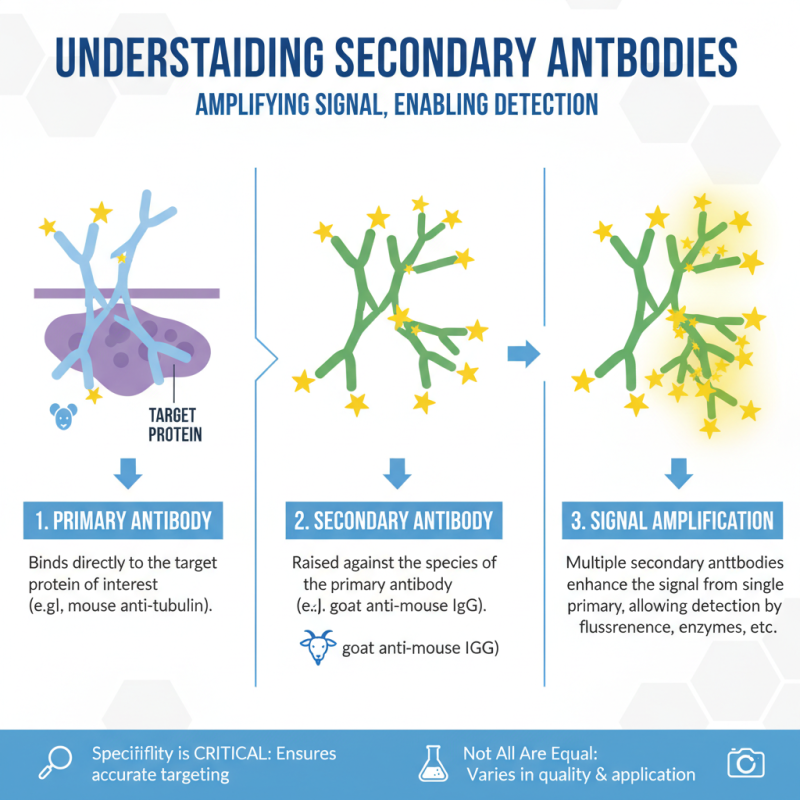
Selecting the right secondary antibodies is crucial for successful research outcomes. Dr. Emily Chen, a leading expert in immunology, states, “The choice of secondary antibodies can profoundly impact signal detection and assay sensitivity.” This highlights the importance of making informed decisions in antibody selection.
Secondary antibodies are used to enhance the detection of primary antibodies. They bind to these primary antibodies, amplifying the signal for visualization. Yet, navigating the vast array of secondary antibodies can be overwhelming. Each antibody has unique properties, such as species reactivity and conjugation types. Researchers often face challenges when matching secondary antibodies to their specific experimental setups.
Understanding these nuances is vital. A poor choice can lead to weak signals or high background noise. Furthermore, not all secondary antibodies are created equal, which can introduce variability. It’s essential to critically evaluate data sheets and peer-reviewed studies to ensure reliability. An informed choice can make a notable difference in obtaining clear and reproducible results.

Secondary antibodies play a critical role in various research applications. They enhance the signal detection of primary antibodies, allowing for better visualization of specific proteins. In most cases, secondary antibodies are raised against the species from which the primary antibodies are derived. This specificity is key for accurate results. However, not all secondary antibodies are created equal.
When selecting the right secondary antibody, various factors must be considered. The conjugation type is important; options include enzymes or fluorophores. Each type serves a different purpose. Experimenters should also pay attention to the cross-reactivity to minimize background noise. This can often lead to misleading results.
While some researchers may assume all secondary antibodies work similarly, this is not always the case. It's crucial to validate every choice through pilot experiments. The lack of a systematic approach may result in inconsistent data. Emphasizing thorough evaluation and peer advice can significantly improve experimental outcomes. Ultimately, understanding these nuances contributes to the reliability of research findings.
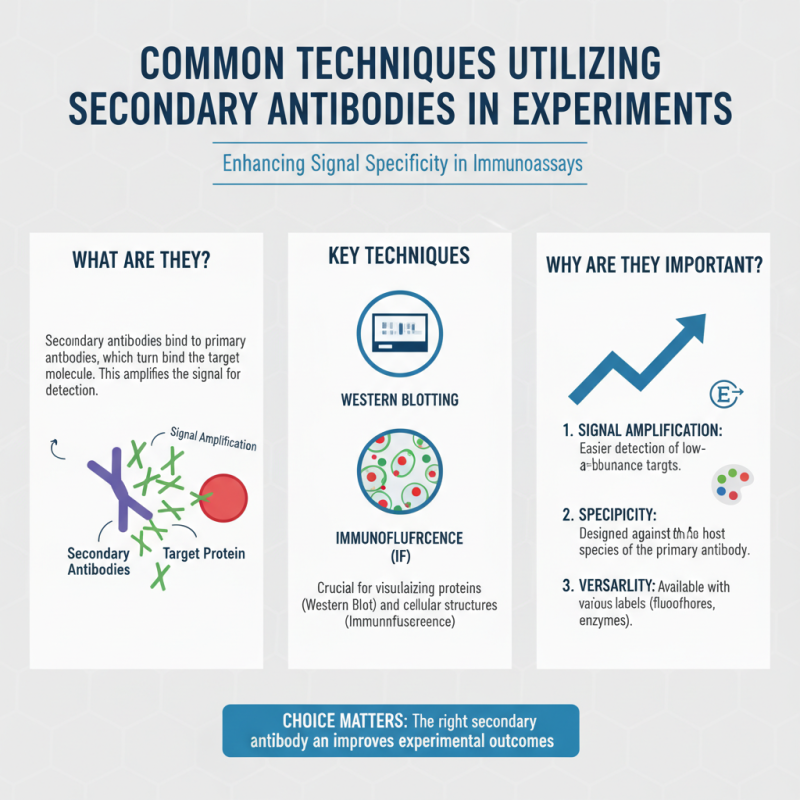
Choosing the right secondary antibodies can significantly impact your experimental outcomes. Different types offer distinct benefits, suitable for various applications. For example, unconjugated secondary antibodies allow flexibility for later detection methods, such as enzyme-linked assays. On the other hand, conjugated secondary antibodies provide direct visualization in techniques like fluorescence microscopy.
Polyclonal and monoclonal secondary antibodies serve different purposes. Polyclonal antibodies recognize multiple epitopes, increasing sensitivity. However, they may show higher background signals. Monoclonal antibodies are specific to one epitope, ensuring minimal cross-reactivity. This specificity can lead to more reliable results but may require optimization.
Understanding your target is critical. Consider the host species of your primary antibody when selecting a secondary one. Misalignment can lead to ineffective binding. Cross-reactivity is another aspect to reflect on. Choosing a secondary antibody with minimal cross-reactivity for your experimental setup enhances the accuracy of interpretations. Each choice can shape research outcomes; thus, careful selection is essential for successful results.
Selecting the right secondary antibodies is crucial for the success of your experiments. Various factors must be considered to ensure proper performance. The specificity of the secondary antibody is one key aspect. Research shows that approximately 20% of experimental errors stem from non-specific binding. Choosing an antibody that recognizes the specific isotype of your primary antibody reduces these errors.
Another important factor is the host species. It's essential that the secondary antibody is raised against the species in which your primary antibody was generated. For instance, using an anti-rabbit IgG to detect a rabbit primary antibody prevents cross-reactivity issues. According to industry reports, nearly 30% of researchers encounter problems due to species mismatch, leading to misleading results.
Fluorophore selection also plays a significant role. Different fluorophores have varying levels of brightness and photostability. A study published in a leading journal highlighted that 40% of researchers reported challenges in signal detection due to inadequate fluorophore choices. Such missteps highlight the need for careful consideration in selecting secondary antibodies for optimal visualization and accurate data analysis.
Secondary antibodies are crucial in various laboratory techniques, enhancing the specificity of signals in experiments. Common methods like Western blotting and immunofluorescence rely heavily on these antibodies to visualize primary targets. By binding to primary antibodies, secondary antibodies amplify the signal, making detection easier. The choice of secondary antibody can influence the outcome of your findings.
When working with Western blots, consider the species of your primary antibody. If your primary is from a rabbit, use a secondary antibody that targets rabbit IgG. This specificity is vital for clear results. In immunofluorescence, select secondary antibodies conjugated with fluoro-for dyes that match your detection setup. This ensures compatibility and enhances signal clarity.
**Tips:** Check the host species of your primary antibody. This prevents cross-reactivity. Also, think about the detection method you are using. Some secondary antibodies perform better with certain detection systems. Experimentation can reveal unexpected results, but careful observation is key. Optimizing your secondary antibodies will refine your experiments, leading to more reliable data.
When conducting experiments with secondary antibodies, challenges may arise that impact results. One common issue is background noise. If your blots or tissue samples exhibit high background staining, it could be due to improper dilution. Adjusting the concentration of your secondary antibody can often help minimize this interference. Moreover, the blocking serum used should match the host species of the secondary antibody. If not, it could compromise specificity and lead to misleading results.
Another issue to consider is non-specific binding. This problem can obscure your target signal. To address this, experiment with different blocking buffers or increase the washing steps. Incorporating additional washes can significantly reduce residual binding. It’s also essential to validate the specificity of the secondary antibodies through control samples. If your primary antibody doesn't properly bind, no amount of secondary antibody adjustments will rectify that.
Cross-reactivity is a frequent source of frustration. Choosing antibodies that are known for low cross-reactivity can help. If you are unsure, perform a thorough literature review. Although it may take time, this step can prevent future headaches. Keep detailed records of all antibody conditions used. This practice aids in troubleshooting. It also allows for more precise adjustments in the future.
| Dimension | Description | Example |
|---|---|---|
| Host Species | The species from which the primary antibody is derived | Mouse, Rabbit |
| Type of Detection | Method used to visualize antibody binding | Fluorescent, Enzyme-linked |
| Cross-Reactivity | The ability of the secondary antibody to bind to non-target species | May react with other species' immunoglobulins |
| Fluorochrome/Enzyme | The label attached to the secondary antibody for detection | FITC, HRP |
| Conjugation Type | Whether the secondary antibody is directly conjugated to a reporter molecule | Directly conjugated, Non-conjugated |
| Application | Experimental setup for which the secondary antibody is used | Western Blot, Immunohistochemistry |