What is the Role of Secondary Antibodies in Immunoassays?

Immunoassays are critical tools in diagnostics and research. They rely heavily on primary and secondary antibodies. Secondary antibodies enhance detection sensitivity and specificity. Data from industry reports indicate that the global antibody market is expected to reach $300 billion by 2025. This growth is driven by advances in immunoassay technologies.

Secondary antibodies bind to primary antibodies, amplifying the signal. They can be labeled with enzymes or fluorescent dyes. This labeling allows for easier visualization and quantification. However, not all secondary antibodies are equal. Choosing the right one can be challenging, and it requires careful consideration. Cross-reactivity can lead to false results, impacting research outcomes.

Moreover, the importance of validation cannot be overstated. While secondary antibodies are powerful, they must be tested in context. Inadequate testing may lead to misleading conclusions. Researchers must approach this with diligence, considering factors such as source and batch inconsistencies. The balance between sensitivity and specificity remains a critical consideration in the field.

What is the Role of Secondary Antibodies in Immunoassays?

Definition and Function of Secondary Antibodies in Immunoassays

Secondary antibodies play a crucial role in immunoassays. They bind specifically to primary antibodies. This binding amplifies detection signals. Secondary antibodies are often conjugated with enzymes or fluorophores. These labels enhance visualization and quantification of target antigens.

The use of secondary antibodies in assays can vary significantly. Different applications may require unique properties. For example, some may need higher specificity, while others rely on sensitivity. It's also essential to consider cross-reactivity. This unintended binding can lead to misleading results. Researchers must carefully validate each component.

However, not all secondary antibodies perform equally. Variations in quality can impact data reliability. Sometimes, experimental design overlooks critical controls. This oversight could result in false positives or negatives. Understanding these nuances is vital for producing accurate outcomes in immunoassays. Continuous evaluation and adjustment are necessary for success in this field.

What is the Role of Secondary Antibodies in Immunoassays?

Aspect Details
Definition Secondary antibodies are antibodies that bind to primary antibodies in immunoassays, enhancing signal detection.
Function Increase sensitivity and specificity of assays, allowing for the visualization of binding interactions.
Types Enzyme-conjugated, fluorochrome-conjugated, and biotinylated secondary antibodies are common types.
Applications Used extensively in ELISA, Western blotting, immunofluorescence, and flow cytometry.
Advantages Amplification of signal, reduction in required primary antibody concentration, and versatility in detection systems.
Limitations Potential for cross-reactivity, background noise, and need for careful optimization in assay development.

Types of Secondary Antibodies Used in Common Immunoassays

What is the Role of Secondary Antibodies in Immunoassays?

Secondary antibodies play a critical role in immunoassays. They enhance the signal of the primary antibodies, making detection easier. There are several types of secondary antibodies commonly used in these assays. These include enzyme-linked antibodies, fluorescent antibodies, and biotin-conjugated antibodies.

Enzyme-linked secondary antibodies are often used for colorimetric assays. They react with substrates to produce a measurable color change. On the other hand, fluorescent secondary antibodies are useful in techniques like flow cytometry. Their ability to emit light can be detected using specific instruments. Biotin-conjugated antibodies are versatile and can be amplified further with streptavidin, enhancing sensitivity.

Tip: When selecting a secondary antibody, consider its host species. Using the correct species can improve specificity. Remember, sometimes secondary antibodies are cross-reactive. You may need to test them for your specific application. Another tip is to optimize the concentration. Too high a concentration can lead to background noise in results. Always validate your results to ensure accuracy.

Mechanisms of Signal Amplification by Secondary Antibodies

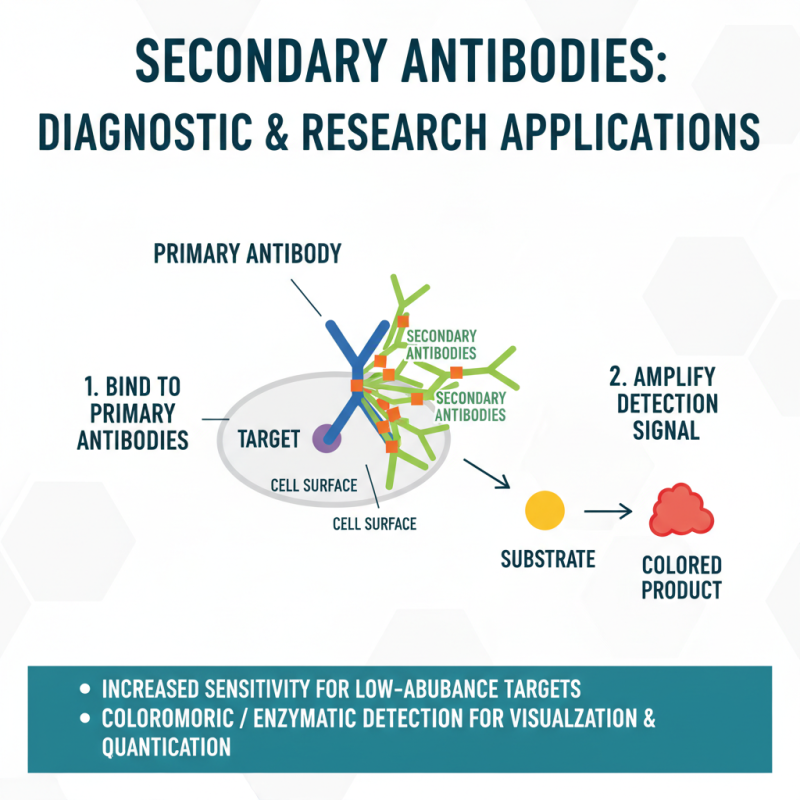
Secondary antibodies play a crucial role in immunoassays. They bind to primary antibodies and help amplify the signal. This amplification is vital for detecting low-abundance proteins. Without secondary antibodies, many targets would remain undetected.

The mechanism of signal amplification involves several steps. When a secondary antibody attaches to a primary antibody, it can carry enzymes or fluorescent tags. These tags enhance visibility. For example, an enzyme can produce a color change in the presence of a substrate. This step provides a clearer result. Sometimes, this process doesn't work as intended. Issues can arise with antibody specificity or secondary binding.

Understanding these mechanisms is essential for optimizing experiments. The choice of secondary antibodies can affect sensitivity. Researchers must consider factors such as cross-reactivity and concentration. There are cases where results can be misleading or weak. Balancing these details is necessary for effective assays.

Importance of Secondary Antibody Specificity and Cross-Reactivity

Secondary antibodies play a critical role in immunoassays. They provide enhanced signal detection. Their specificity to the primary antibodies is crucial. This specificity ensures that the binding is accurate and reliable. If a secondary antibody binds to unintended targets, results may be misleading. Cross-reactivity can complicate data interpretation. It’s essential to select secondary antibodies with minimal cross-reactivity.

The choice of secondary antibodies directly affects the outcome. Cross-reactivity may lead to increased background noise in experiments. This interferes with the clarity and resolution of results. Scientists often overlook the importance of thorough validation. Testing for specificity can prevent false positives and false negatives. A thorough understanding of the secondary antibody’s properties is necessary.

Selecting ideal secondary antibodies requires careful consideration. They should be validated for the specific species of primary antibodies. This includes understanding the binding affinities and any potential interactions. In some cases, researchers may find that a secondary antibody does not perform as expected. Thus, continuous evaluation and adjustment are essential in immunoassay development.

This chart illustrates the significance of secondary antibodies in immunoassays, highlighting their specificity and potential cross-reactivity. The data indicates that specificity is crucial (85%) compared to the minor concern of cross-reactivity (15%).

Applications of Secondary Antibodies in Diagnostic and Research Settings

What is the Role of Secondary Antibodies in Immunoassays?

In diagnostic and research settings, secondary antibodies play a crucial role. They bind to primary antibodies, amplifying the detection signal. This amplification increases sensitivity, allowing for the detection of low-abundance targets. For instance, a secondary antibody conjugated with an enzyme can produce a color change upon substrate addition. This colorimetric change makes results easier to visualize and quantify.

Secondary antibodies are widely utilized in various immunoassays. In ELISA, they help measure antigens in samples like blood. In Western blotting, they allow researchers to confirm protein presence. However, choosing the right secondary antibody can be challenging. Cross-reactivity can lead to false positives. Thus, careful validation is necessary. Each experiment demands meticulous design to avoid pitfalls. Sometimes, results are ambiguous, requiring more troubleshooting.

The importance of secondary antibodies cannot be overstated. They enhance sensitivity in crucial diagnoses. Yet, the need for rigorous experimental controls remains. Researchers must recognize the balance between amplification and specificity. In some cases, the best results come from repeated trials and method revisions. Adaptability is vital in optimizing these assays.

Search engine powered by ElasticSuite